Independently tested: what 'H13 HEPA, 99.97%, EN 1822' really means
In dit artikel
“HEPA filter.” “99% of allergens.” “Hospital quality.” Such terms are found on almost every mattress vacuum cleaner. But how do you know if they are accurate? Most claims are never independently verified. That's why we had the MiteMaster® filter medium tested by an accredited laboratory according to the European standard EN 1822. In this blog, we explain what that standard entails, what exactly was measured, and — honestly — what the test does and doesn't say.
What is a HEPA filter, and what does 'H13' mean?
HEPA stands for High Efficiency Particulate Air: a filter that retains a very high percentage of the smallest airborne particles. HEPA filters are categorized into classes. H13 is the class found in better air purifiers and mattress vacuum cleaners: an H13 filter must, according to the standard, retain at least 99.95% of particles. This is relevant for dust mite allergies, as you primarily react to the proteins in mite feces, as also described by Thuisarts.nl — and these are microscopically small particles.
EN 1822: testing for the trickiest particle
EN 1822 is the European standard by which HEPA filters are classified. The unique aspect of it is that a filter is not tested on large, easy-to-capture particles, but on the most difficult particle to capture — known in the professional world as MPPS (Most Penetrating Particle Size). This size is around 0.1–0.25 micrometers. Particles of that size most easily slip through a filter. If a filter performs well there, it performs well everywhere. This way, the standard prevents a filter with an outwardly impressive average from secretly letting through the smallest particles.
Our result: 99.97%
The H13 HEPA filter medium of the MiteMaster® was tested at an independent, accredited laboratory (CNAS L8342, internationally recognized via ILAC-MRA). The measured capture efficiency for these most penetrating particles (0.10–0.25 µm) was 99.97% — well above the 99.95% required for class H13. For slightly larger fractions, this increased to 99.98%.
You don't have to take our word for it: we have summarized the key data in a certification overview (PDF), including the testing institute, the standard, the measured values, and the report number.
Honestly: what the test does and doesn't say
Transparency is essential. This test concerns the filter medium — the material from which the filter is constructed — tested as a flat sheet according to EN 1822 and EN ISO 29463-3. The figure of 99.97% is therefore the efficiency of the filter material itself: it indicates how well the filter retains particles that reach it. What a filter cannot do is capture particles that never reach it — and that's why the rest of the design is just as important.
A filter is only one link
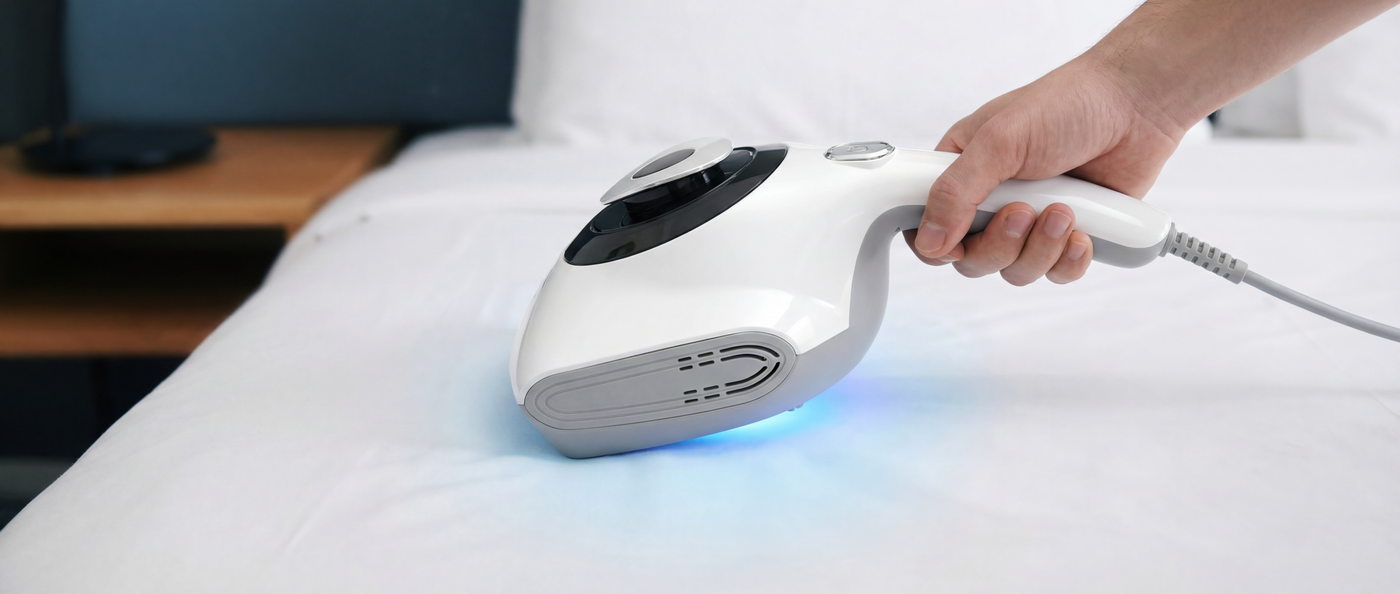
A good filter does little if allergens remain deep within your mattress. That's why the MiteMaster® works in three steps: a high-frequency vibrating plate loosens mites and allergens from the fibers, the suction power draws them away, and only then does the H13 HEPA filter retain them instead of blowing them back into the room. The built-in UV-C lamp adds an extra layer of hygiene to the surface during cleaning, but the real work — removal — happens mechanically. The GGD, for example, points out that with regular vacuuming, mite feces are partly blown out again — precisely what a good HEPA filter is supposed to prevent.
Why we consider this important
The market for 'anti-dust mite' devices is full of grand promises and little proof. We prefer claims that can be verified. An independent test report is not marketing — it's a third party that measures and records. That gives you, as a buyer, certainty, and it keeps us sharp.
Getting started
Do you want a fresher, allergen-reduced bed? Check out the MiteMaster® MX6 (vibrating plate, 12 kPa) or the more powerful MiteMaster® MX9 Pro (dual rotating brush, 14 kPa). Both use the same independently tested H13 HEPA filter.