
Where is dust mite found in the house?
Dust mites are not equally abundant everywhere. They gather where three things converge: dead skin cells, moisture, and fibers to burrow into. If you know where that is, you also know where to start—and where not to waste your time.
- In your mattress
- approximately 1.5 million
- Exposure
- 8 hours per night
- Wash temperature
- 60°C
- Humidity
- below 50%
The rooms in the house
From largest source to smallest. You have to choose where your time and money go: bed first, couch second, floor third.
-
Your mattress
Exposure: Very HighBy far the biggest source. Eight hours a night, moisture and dead skin cells, and it can't go in the washing machine. A mattress lasts ten years: what you leave in it in year two, is still there in year eight.
Hier let je op Ten minutes weekly, both sides, including seams and edges.Rode vlag Replacing your floor when your mattress has never been cleaned. -
Pillows and duvet
exposure: highClose to your face, so the exposure per gram is high. Good news: many pillows and duvets can simply be machine washed.
Hier let je op Check the wash label. If it can be washed at 60°C, this kills mites and washes away allergens.Rode vlag Washing at 40°C. This doesn't reliably kill the mites. -
Your bank
exposure: highThe forgotten source. You sit on it for hours in the evening, often with bare arms and legs, and it's never washed. Most of it collects under the loose seat cushions and in the seams.
Hier let je op Remove cushions separately from both sides, and wash decorative pillow covers with them.Rode vlag Only do the visible surface and skip the cracks. -
Cuddly toys and children's textiles
exposure: averageA cuddly toy that goes to bed with you every night is a mini mattress.
Hier let je op Wash at 60°C where possible. If not possible: put in the freezer overnight AND then wash.Rode vlag Only freeze it. The mites will be dead, but the allergen will still be present. -
Carpets and floor coverings
exposure: averageDefinitely a reservoir, but per gram of substance usually less allergen-rich than a mattress. High-pile is more unfavorable than low-pile.
Hier let je op Slowly vacuum with a device with a demonstrable filter class, and ventilate while vacuuming.Rode vlag Install a smooth floor and then never mop it wet. -
Curtains, box spring, and cracks
exposure: lowLittle exposure per hour, but there are places where dust builds up for years if you never go there.
Hier let je op Include a few times a year in a larger round.Rode vlag Starting here while your mattress hasn't been taken care of yet. -
And where is it definitely not? In the air
exposure: negligibleDust mite allergen particles are relatively heavy. They briefly float up when you turn over in bed and settle again within minutes. Also not: in wood, stone, or on a smooth floor – without fibers and moisture, there is no living environment.
Hier let je op Focus on textiles, not on the air.Rode vlag Buying an air purifier for dust mites. It makes more sense for pollen or pet allergens.
If your symptoms persist despite these measures, discuss them with your general practitioner. Not every morning congestion is caused by dust mites.
Three measures, in this order
Two of them cost nothing. The third is for anything that doesn't fit in the washing machine.
-
Wash what you can
60°C, weeklyBedding, pillowcases and many duvets can be washed at 60 degrees. This kills the mites and washes away the allergen - the only measure that does both.
-
Keep dry
below 50% humidityDust mites absorb moisture from the air. Ventilate for ten minutes every morning with the window wide open, and leave your bed unmade instead of making it immediately. A hygrometer costing a few euros can make this measurable.
-
Cleaning what can't be cleaned
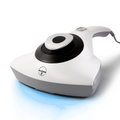
mattress, sofa, cushionsLoosen from the fibers, vacuum, and hold in a filter that is fine enough. Otherwise, you're just moving the allergen instead of removing it.
Start with the largest source
Ten minutes per mattress, once a week. Don't notice a difference? Return it free within 30 nights.
Where is dust mite found in the house?
Why the order matters
The advice people with a dust mite allergy most often receive is "remove the carpet." That's not nonsense, but it's rarely the advice with the highest return on investment. The amount of allergen per gram of dust in a mattress is usually many times higher than in carpeting, and you spend eight hours with your face on it.
Replacing carpeting while your mattress is never cleaned is starting with the smaller source. If you have to choose where your money and time go: bed first, sofa second, floor third.
A smooth floor is not automatically better
On a hard floor, dust doesn't get caught in fibers, but it does swirl up more easily with every airflow. A smooth floor that you rarely damp mop can create a worse situation than low-pile carpet that you vacuum thoroughly weekly. The advantage of smooth isn't that there's no dust, but that you can completely remove it — with a damp cloth, not with a dry duster that blows it around.
The pitfall of vacuuming
The GGD (Dutch Public Health Service) points out that during regular vacuuming, mite droppings are partly blown back out. Without a fine final filter, you're therefore moving the allergen from your mattress to the air in your bedroom. That's why filtration for this specific problem is more important than suction power alone.
We had the filter medium of the MiteMaster® independently tested according to EN 1822 by an accredited laboratory: 99.97% capture for the hardest-to-capture particle size, against a class requirement of 99.95% for H13. You can read the measurement data and report number.