Dust mites in carpet and carpeting: should it go?
In dit artikel
"Remove the carpet" is the most common advice given to people with a house dust mite allergy. It's not nonsense, but it's also not the whole story — and it's expensive advice if you've just laid a new floor. What's true about it, and what can you do if you want to keep your floor?
Why carpet is mentioned
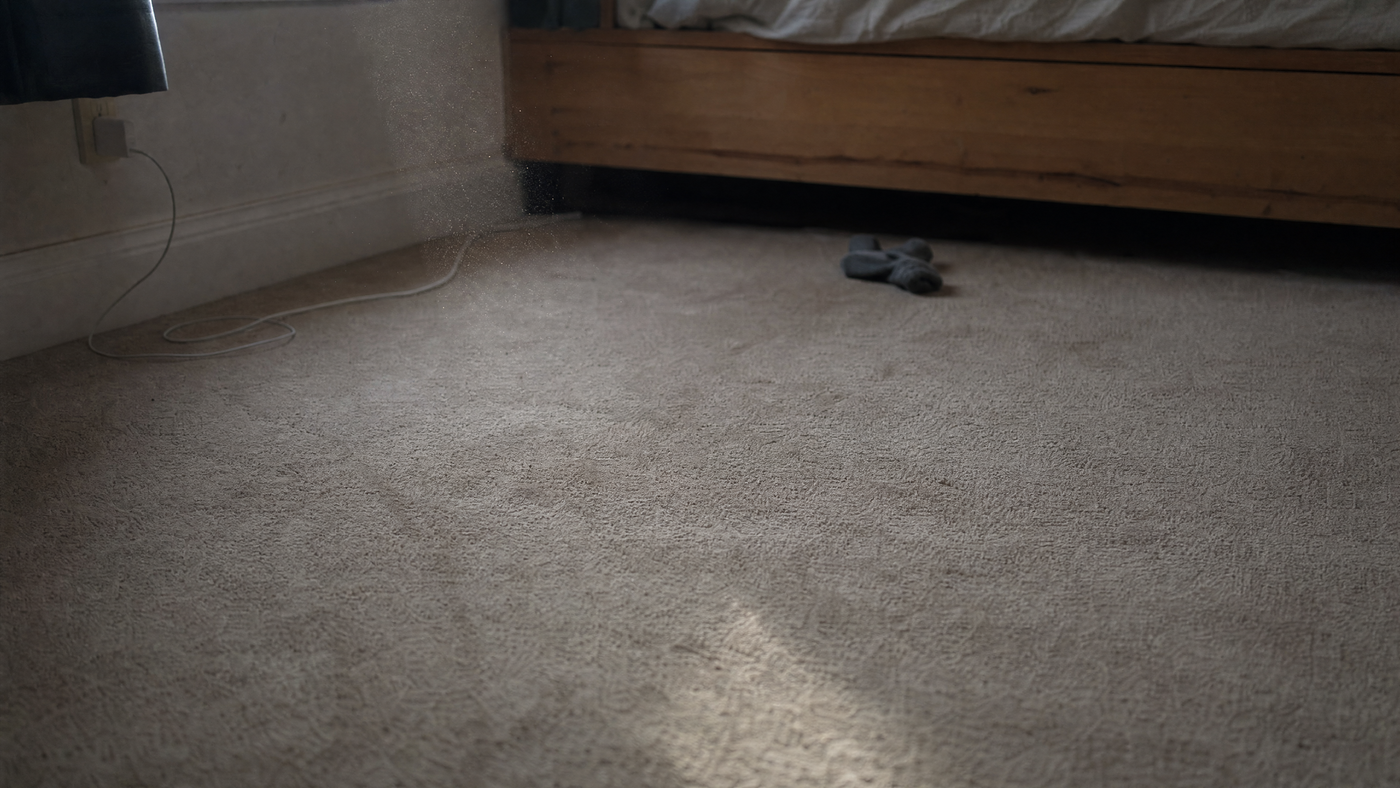
Carpeting is a reservoir. Fibers capture and hold skin flakes, pet hair, and dust. High-pile carpet is worse than low-pile in this regard: more volume, deeper layers, harder to vacuum.
There's a second point that's often forgotten: a floor is walked on. Every step compresses air from the fibers and kicks up fine particles, precisely at the height where you inhale them. This also happens with a smooth floor, but there you can simply remove the dust.
But: the bedroom counts more heavily
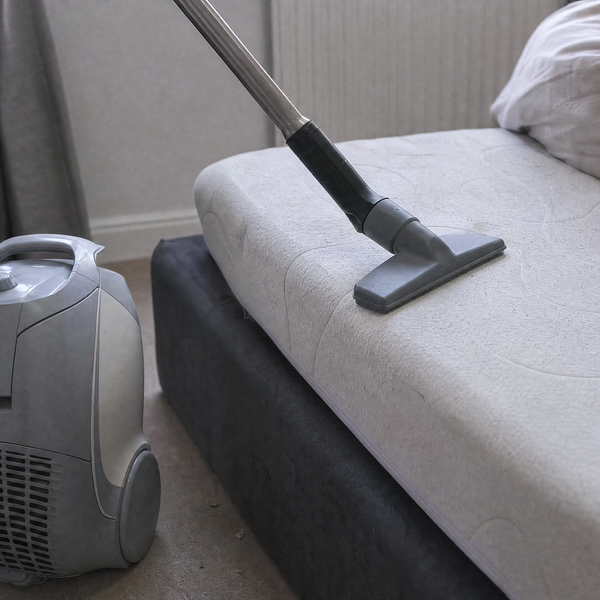
This is where the advice often goes wrong. The amount of allergen per gram of dust in a mattress is usually many times higher than in carpeting, and you lie with your face on it for eight hours. Replacing carpeting while your mattress is never cleaned is starting with the smaller source.
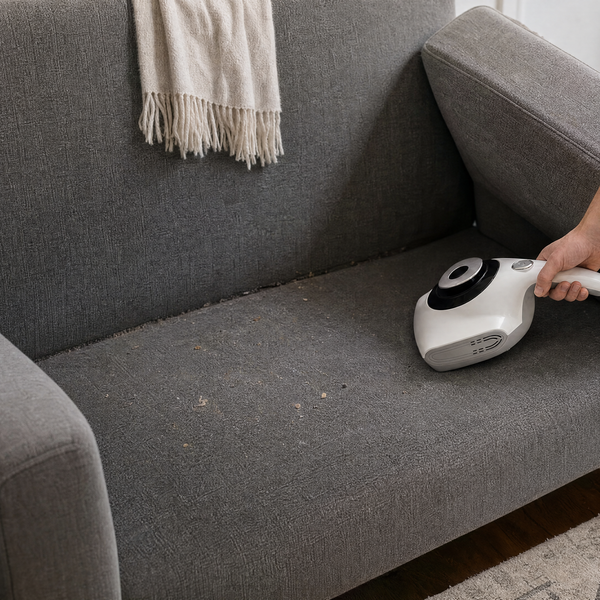
If you have to choose where your money and time go: bed first, sofa second, floor third.
If you keep your carpeting
- Choose low-pile over high-pile. If you are replacing it anyway, this makes more difference than going from carpet to laminate with a large rug on top.
- Vacuum slowly. Going over a strip calmly twice removes more than going back and forth quickly six times.
- Pay attention to the final filter. This is more important for floors than for any other surface, because you cover so many square meters and the exhaust is at breathing height.
- Wash loose rugs at 60°C if the size allows.
- Ventilate during and after vacuuming.
A hard floor is not automatically better
This is the nuance that is rarely mentioned. On a smooth floor, dust does not get stuck in fibers, but it does swirl up more easily with every airflow. A hard floor that you rarely mop can create a worse situation than low-pile carpet that you vacuum thoroughly weekly.
The advantage of smooth is not that there is no dust, but that you can remove it completely. You only capitalize on that advantage if you actually do it — with a damp cloth or mop, not with a dry duster that blows it around.
The pitfall of vacuuming
The GGD points out that with normal vacuuming, mite droppings are partly blown out again. On a floor of twenty square meters, you therefore blow a lot of air around, and everything that the filter does not retain ends up in the room where you are at that moment.
That is why filtration weighs more heavily here than suction power. We had the filter medium of the MiteMaster® independently tested according to standard EN 1822, at an accredited laboratory: 99.97% capture for the most difficult to capture particle size, against a class requirement of 99.95% for H13. The measurement data and report number are available online.
The MiteMaster® is designed for mattresses, sofas and upholstered surfaces — not as a replacement for your regular floor vacuum cleaner. The same principle applies to carpeting: look at what the device blows out at the back.
In summary
Removing carpet is a real recommendation, but rarely the recommendation with the highest return per euro. Start with your mattress, add your sofa, and tackle your floor with attention to filtration instead of immediately replacing it. If you are faced with a choice, choose low-pile or smooth — and actually mop that smooth floor.