Is a regular vacuum cleaner enough against dust mites?
In dit artikel
If you've just bought an expensive vacuum cleaner, this is a legitimate question: do I need anything else in addition to it? The honest answer doesn't depend on the brand or the wattage, but on three characteristics. Go through them and you'll know for yourself.
Characteristic 1: Does it come from the deeper layers?
The allergen you react to—proteins from mite droppings—is not loose on your mattress. It is clamped between the fibers, centimeters deep. Suction power alone only removes a limited amount of it, no matter how many Pascals are on the box.
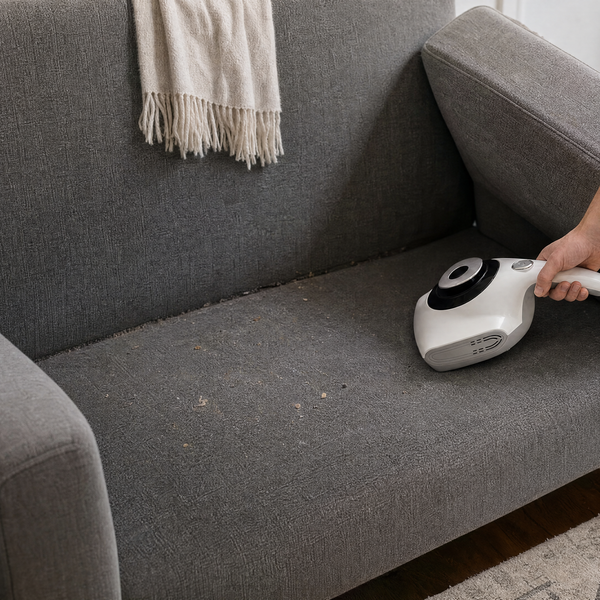
What makes the difference is mechanical movement: a high-frequency vibrating plate or rotating brush that moves the fibers so that the material comes loose and can be picked up. If your vacuum cleaner only has a smooth furniture brush, this step is missing. That's not a judgment of quality—an excellent floor vacuum cleaner simply isn't designed for it.
Characteristic 2: Does it stay inside?
This is the point most often overlooked. The GGD (Dutch Municipal Health Service) points out that during regular vacuuming, mite droppings are partly blown out again. A device with a mediocre final filter therefore moves the allergen from your mattress into the air in your bedroom.
Note the difference here between "HEPA filter" as a word and a filter with a demonstrable class. Ask for three things:
- the standard it was tested against (EN 1822 for HEPA filtration);
- the class (H13 captures at least 99.95% of the most difficult to capture particle sizes);
- a report number and the testing institute.
If you only get a percentage without a standard, you don't know what it was measured against. "99% down to 0.3 microns" sounds good, but means little if the most difficult particle fraction is disregarded.
Characteristic 3: Does it leak past the filter?
A filter can be excellent while the device still allows dust to pass through, namely along the edges. In bagless models, the weak point is often when emptying the reservoir: you open it and the finest fraction is released anyway. Therefore, empty the reservoir outdoors or over a sealed waste bag, not over the kitchen trash can.
What does this mean for your vacuum cleaner?
If you have a good vacuum cleaner with true H13 filtration and a brush attachment that moves, you'll go a long way—then work slowly, about five centimeters per second, and do both sides of your mattress.
If you have a good vacuum cleaner without mechanical agitation, you mainly remove the surface. Better than nothing, but the supply in the deeper layers largely remains.
If you have a device without a demonstrable filter class, there's a real chance you'll stir up more on your mattress than you remove. In that case, vacuuming less often and washing more often at 60°C is a better trade-off.
What about a steam cleaner?
Heat kills mites, that's true. But steam introduces moisture into a mattress that dries slowly, and moisture is exactly what dust mites need. Moreover, the allergen remains after killing: dead mites, residual proteins. Fine for smooth surfaces, but for a thick mattress, the risk is greater than the reward.
What we've been tested against
The MiteMaster® deliberately combines the three steps: a vibrating plate loosens, suction removes, and an H13 HEPA filter retains. We had the latter independently tested according to EN 1822 at an accredited laboratory—99.97% for the most difficult to capture particle sizes, against a class requirement of 99.95%. You can review the measurement data and report number.
That's exactly the proof we're asking for above. Ask us that question, and ask everyone who sells you a solution.