Dust mites in your sofa: the source everyone forgets
In dit artikel
When thinking about dust mites, almost everyone thinks of the bed. Rightly so: that's where you spend most of your hours. But there's a second place where you lie with your skin against it for hours every day, which collects just as many skin flakes, and which is never washed. Your sofa.
Why a sofa is just as good a habitat
Dust mites need three things: skin flakes, moisture, and a place to hide. A fabric sofa provides all three. You sit on it in the evening, often with bare arms and legs, and the fibers catch what you shed. The filling retains moisture. And because a sofa consists of layers — cover, foam, seams, crevices under the cushions — there is plenty of space.
Unlike a mattress, a sofa gets something extra: visitors, pets, crumbs. Allowing a dog or cat on the sofa doubles the supply of skin flakes.
Where to look for it
Dust doesn't distribute evenly across a sofa. It collects in predictable places:
- Under the loose seat cushions. Almost always the dirtiest spot, and the spot that is cleaned the least.
- In the seams and piping. Everything that rolls off the surface falls into these.
- The backrest at shoulder height. This is where your neck and hair come into contact.
- Decorative pillows. Small, close to your face, and rarely washed.
Decorative pillows are the easiest win of all: with a washable cover, you can simply wash them weekly at 60°C.
Leather and synthetic leather sofas
Here the news is good. A smooth leather sofa offers dust mites hardly any grip: there are no fibers to hide in, and skin flakes remain on the surface, where you can easily remove them. If you have a severe allergy and are about to make a purchase, leather or synthetic leather is the wiser choice.
Do pay attention to the seams and folds. Dust does accumulate there, and with a leather sofa with fabric seat cushions, you're back to square one.
How to tackle a fabric sofa
The order is the same as with a mattress, and the reason is also the same: the allergen is not on the surface but between the fibers.
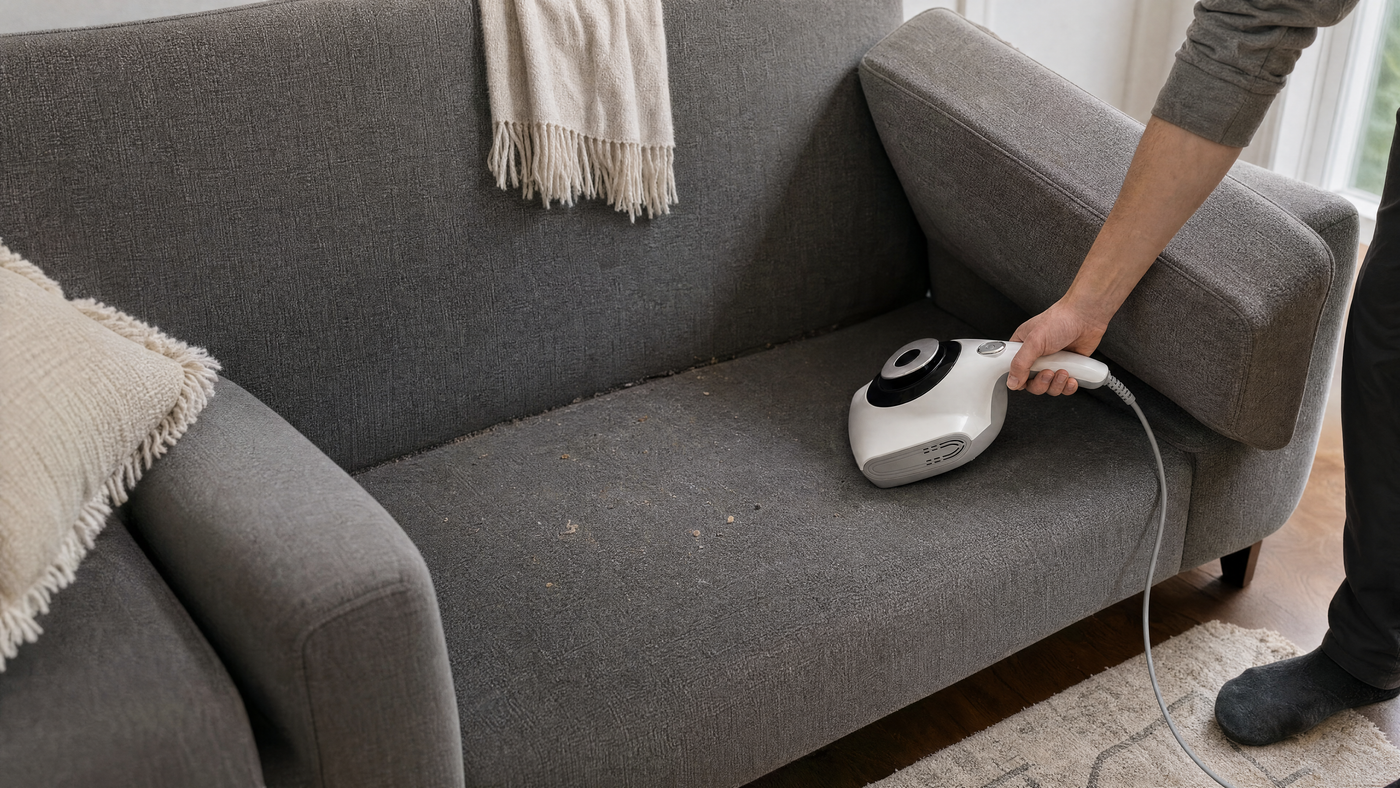
- Remove the loose cushions and first vacuum the base of the sofa, including the crevices.
- Treat each cushion separately, on both sides. Then turn them over.
- Finish the backrest and armrests, slowly, about five centimeters per second.
- Wash what is washable at 60°C: decorative cushion covers, throws, seat cushion covers if they can be removed.
Allow fifteen minutes for a three-seater sofa. Once a week is enough to keep the level low; if you have pets on the sofa, then more often.
Why a regular vacuum cleaner falls short here
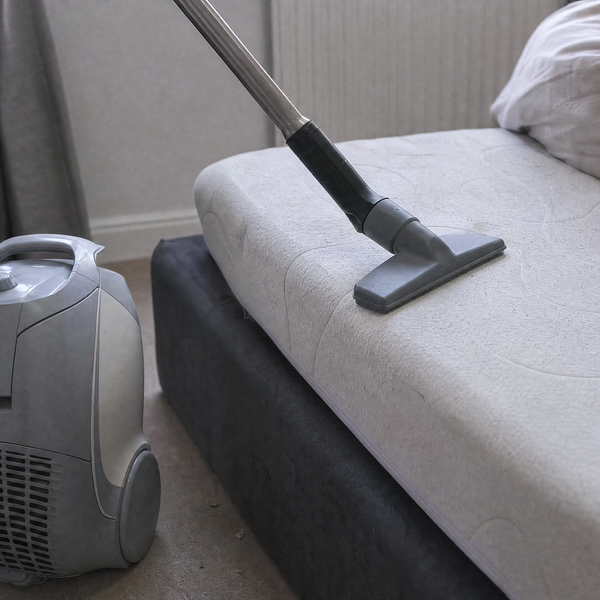
Two reasons. Firstly: suction power alone does not remove ingrained allergens from the fibers. Something is needed to first loosen it — a vibrating plate or a rotating brush.
Secondly, and more importantly: the GGD (Dutch Public Health Service) points out that with regular vacuuming, mite feces are partly blown back out. On a sofa in your living room, that means: you blow fine allergen into the room where you sit for the rest of the evening.
That's why we had the filter medium of the MiteMaster® independently tested according to EN 1822, at an accredited laboratory: 99.97% capture at the most difficult-to-capture particle size. The measurement data and report number are online. If you have pets on the sofa, the MX9 Pro with double rotating brush is more practical, as it removes hair better from the fibers.
Finally
If you clean your mattress weekly and never your sofa, you maintain a source that can be just as significant. Include it in the same round — it takes an extra fifteen minutes and makes a difference in the evenings, when many people start to feel their symptoms.