Cleaning your mattress cover or mattress? What you need when
In dit artikel
Anyone with a dust mite allergy will, sooner or later, face this choice: buy an anti-allergy mattress cover, or regularly clean the mattress itself. They are often presented as alternatives, but they do something fundamentally different. The question is not which is better, but what your situation requires.
The difference in one sentence
A cover shields: the allergen remains in the mattress, but no longer reaches you. Cleaning removes: you actually extract the material from the fibers. The first is a barrier, the second is cleaning up.
That difference also determines what happens if you stop. If you remove the cover, the allergen is still there. If you stop cleaning, it will slowly build up again - but you won't be starting at the same level.
When a cover is the better choice
Of the non-mechanical measures, the mattress cover is the best substantiated. Choose it if:
- you have an old mattress that you will be replacing soon anyway;
- your symptoms are severe and you want a quick barrier between you and the source;
- it's a guest bed or a mattress you rarely use;
- you prefer a one-time purchase over a weekly chore.
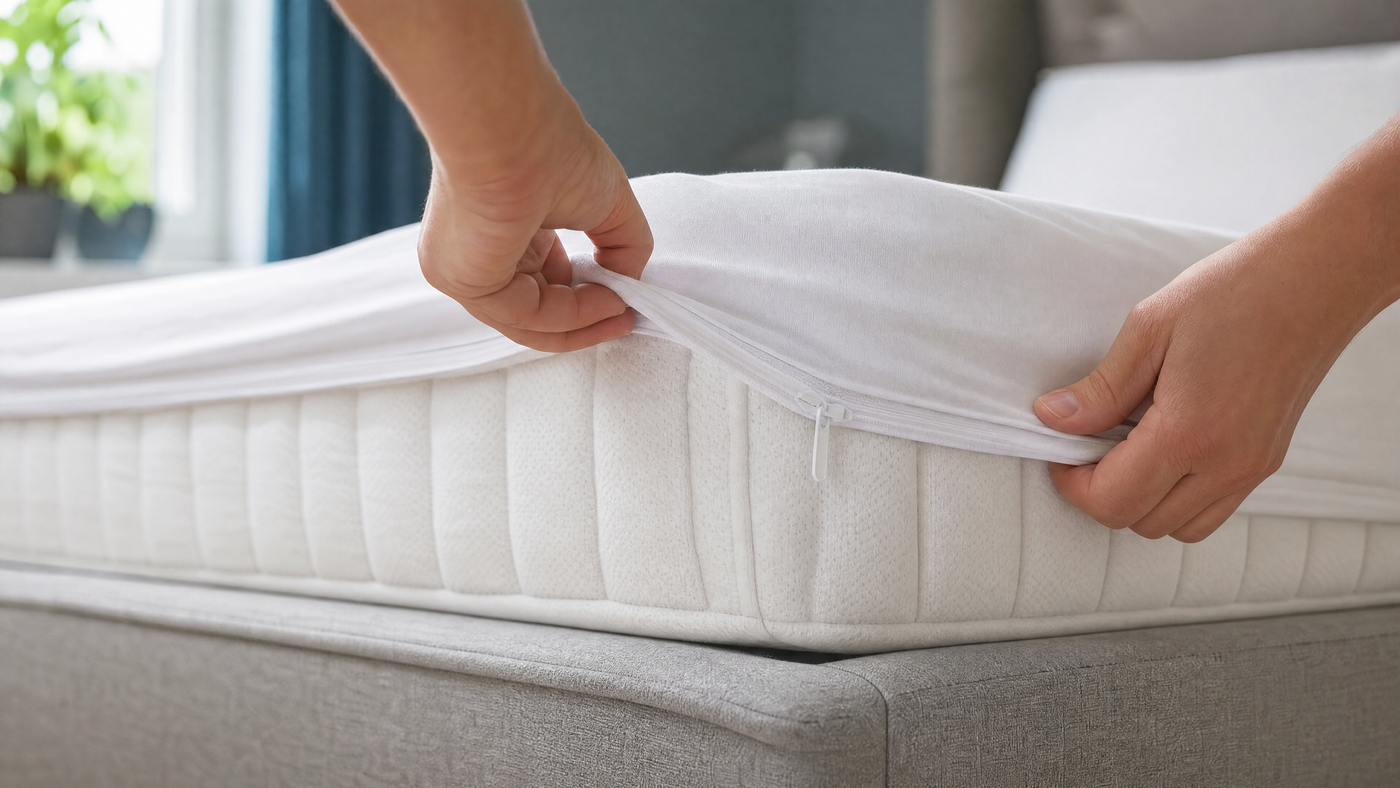
However, pay attention to the design. A cover only works if it fully encloses the mattress with a zipper - a mattress protector or duvet cover over the top is not a barrier. And it needs to be washed periodically, because new material from your skin flakes will simply accumulate on the cover.
When cleaning is the better choice
- you recently bought a good mattress and want to keep it clean;
- you also have a sofa, chairs, or pet beds that cannot be covered;
- a tightly enclosed cover feels too warm or rustles too much;
- you want to tackle the source rather than shield against it.
The latter is more than a matter of principle. The allergen in your mattress won't disappear on its own, and a mattress lasts ten years. What you leave in it in year two will still be there in year eight.
Why the combination is often the answer
In practice, they complement each other. The cover keeps the existing allergen in the mattress. Cleaning keeps the cover, duvet, and the rest of the bedroom clean - because the cover stops at the edge of the mattress, while your pillow, duvet, and sofa fall outside that boundary.
A workable routine looks like this:
- Weekly: Wash bedding at 60°C.
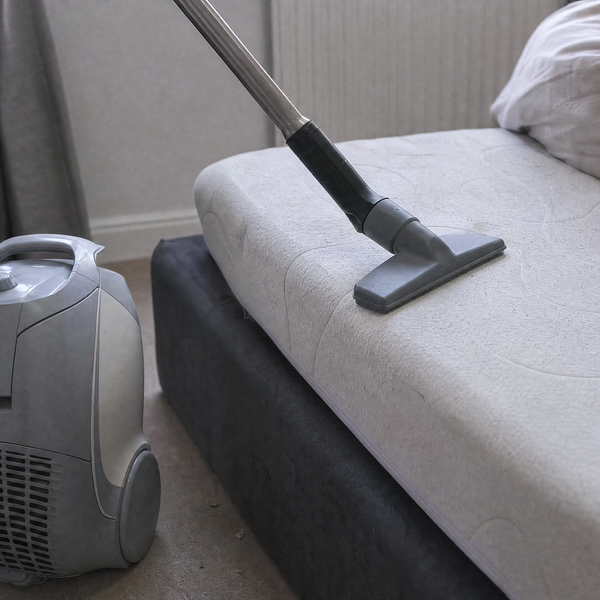
- Weekly: Clean each mattress for ten minutes, plus the sofa you sit on in the evening.
- Monthly: Wash the mattress cover itself.
- Continuously: Keep humidity below 50% by ventilating.
What matters when cleaning
If you choose to clean, the final filter is the component that determines whether you remove the allergen or merely displace it. The GGD (Dutch Municipal Health Service) points out that with regular vacuuming, mite droppings are partly blown back out. Without a fine filter, you are making the air in your bedroom temporarily worse instead of better.
We therefore had the filter medium of the MiteMaster® independently tested according to EN 1822, at an accredited laboratory: 99.97% capture of the most difficult-to-capture particle size, against a class requirement of 99.95% for H13. You can read the measurement data and report number.
In short
A mattress cover is the quickest way to create distance between you and the allergen that is already present. Cleaning is the only way to reduce that allergen, and it also works on everything that cannot be covered. If you are in doubt: start with the cover if your symptoms are currently severe, and with cleaning if your mattress is still new. If your symptoms persist despite both, discuss it with your GP.