Does an air purifier work against dust mites?
In dit artikel
Almost every air purifier mentions "dust mites." However, the answer to the question of whether such a device helps with dust mite allergies is more nuanced than the packaging suggests. In short: an air purifier does something, but not the most important thing. Below, we explain why.
What exactly you're reacting to
You don't react to the mite itself, but to proteins in its droppings. These are found in particles that are relatively large and heavy — on the order of tens of micrometers. That may seem small, but in air purification terms, it's substantial. Such particles do not remain suspended. They briefly swirl up when you turn over in bed or plop onto the sofa, and then settle again within a few minutes.
This is a fundamental difference from, for example, cat allergen, which clings to much lighter particles and can remain in the air for hours. For cat allergies, an air purifier is therefore more logical than for dust mites.
An air purifier only filters what reaches it
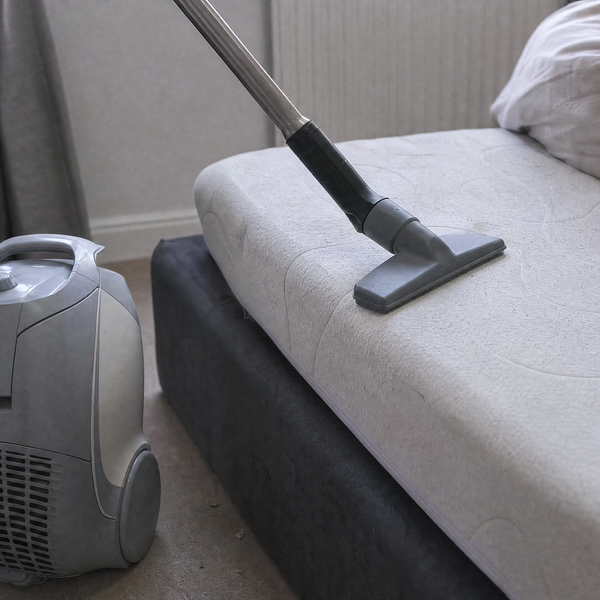
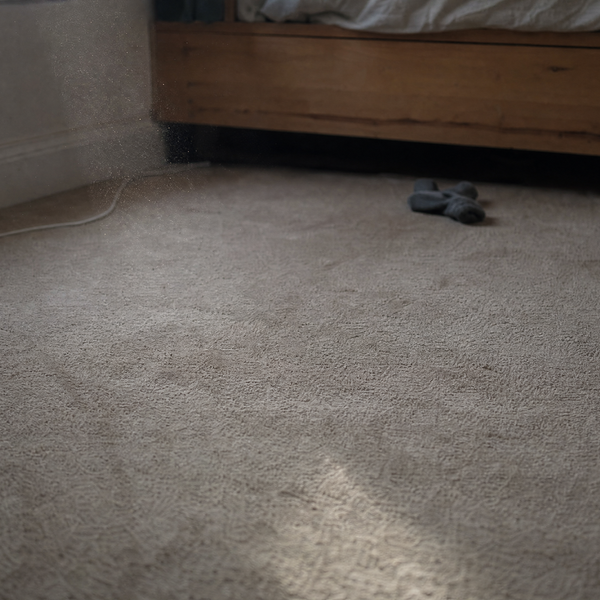
No matter how good the filter is, an air purifier can only capture particles that are drawn through the device. The vast majority of dust mite allergen is not in the air, but deep in the fibers of your mattress, pillow, duvet, sofa, and carpet. Airflow does not reach there.
You can have an excellent H13 filter in an air purifier and still hardly notice any effect on your morning symptoms, simply because the reservoir of allergen is half a meter from your face and not suspended in the air.
What an air purifier DOES do
This is not an argument against air purifiers. They are useful for:
- pollen and hay fever, especially during pollen season with windows closed;
- pet allergens, which remain suspended for much longer;
- particulate matter and smoke, for example, along a busy road;
- odors, with an activated carbon filter.
If you have a combined allergy, an air purifier can indeed make a difference – just not for the dust mite component.
What DOES help with dust mites
Because the allergen is in the textile, the approach must take place there. The measures with the most evidence:
- Wash your bedding weekly at 60°C. Lower temperatures do not reliably kill the mites.
- Keep humidity below 50%. Dust mites absorb moisture from the air and thrive poorly in a dry bedroom. Ventilation is more important here than any device.
- Mechanically remove the allergen from your mattress. Your mattress cannot go in the washing machine, and that's precisely where the largest reservoir is.
- Avoid fabric accumulators in the bedroom: high-pile carpets, many stuffed animals, open bookshelves.
The information from Thuisarts.nl and the tips from the GGD point in the same direction: focus on the sources in the house, not on the air.
Pay attention to one thing when vacuuming normally
The GGD points out that during normal vacuuming, mite droppings are partly blown back out. A vacuum cleaner without a good final filter therefore relocates the allergen instead of removing it. This is why filtration is more important than suction power alone for this specific problem.
We therefore had the filter medium of the MiteMaster® independently tested according to the European standard EN 1822. Measured capture for the most difficult-to-capture particle size: 99.97%. The full measurement data and report number are on the filter page.
What to look for when buying
Whether you are considering an air purifier or a mattress cleaner, ask the same question: has the claim been independently verified? Anyone can put terms like "HEPA" and "99%" on a box. Ask for the standard (EN 1822 for filtration), the class (H13 or higher), and a report number. If you don't get that, you're buying a promise instead of performance.
In summary
An air purifier for dust mites is not nonsense, but it is the wrong tool for the biggest part of the problem. The allergen is in your mattress, not in your air. Start with washing at 60°C, a dry bedroom, and mechanically removing allergens from your mattress and sofa. If your symptoms persist, discuss this with your GP.